AltaSea accelerates scientific collaboration, facilitates job creation and inspires the next generation for a more sustainable ocean.
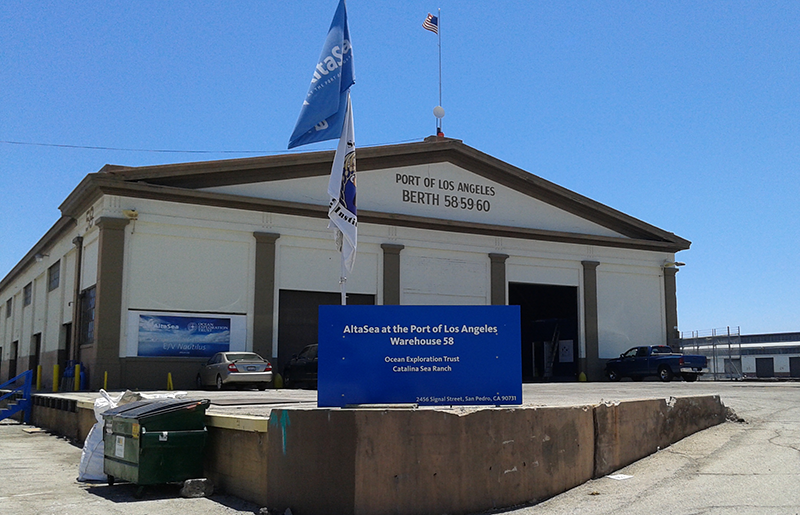
AltaSea is a nonprofit ocean campus at the Port of Los Angeles where scientists, entrepreneurs, educators and students work side by side on the future of the ocean. From its 35-acre home at Berth 60 in San Pedro, it trains local students for ocean careers, helps new ocean businesses grow and create jobs, and tests ways to feed people, power cities and protect marine life without harming the sea.
Serving the community
AltaSea’s education programs bring the harbor’s young people into the ocean economy right in their own backyard.
- Field trips: School groups get hands-on activities, behind-the-scenes tours and conversations with working researchers and entrepreneurs, on topics from kelp forests and artificial reefs to climate solutions and recycling.
- Summer high school mentorships: Students spend the summer on real projects in sustainable ocean farming, marine energy and underwater robotics.
- Classroom curriculum: Teaching units on marine energy, robotics and aquaculture, available in English and Spanish.
- Local partners: More than a dozen LAUSD schools take part, including San Pedro High, Port of Los Angeles High, Dana Middle, Point Fermin Elementary and Cabrillo Avenue Elementary, along with groups such as the Boys & Girls Club of the LA Harbor.
- Open to neighbors: Open houses, campus tours, webinars and the annual Blue Hour celebration invite the public to see the work up close.
Creating jobs
Los Angeles County’s ocean economy supports more than 105,000 jobs and adds over $14 billion a year to the county’s economy, according to a 2025 LAEDC report produced with AltaSea’s support. AltaSea’s goal is to grow those jobs here in the harbor.
- A home for ocean businesses: The Center for Innovation at Berths 58–60 gives start-ups and established companies lab, office and waterfront space, with direct access to deep-water docks and circulating seawater. Tenants include Holdfast Aquaculture and the carbon-removal company Equatic.
- Paid internships that lead to jobs: AltaSea and its tenants have hosted 76 paid internships since mid-2024, and four interns were hired into full-time jobs in 2025 alone.
- Community college pathways: AltaSea helped launch BECAP with Santa Monica College and the LAEDC, a training pipeline for ocean careers that starts with an aquaculture certificate and is planned to grow to fifteen LA County community colleges.
- Skilled trades for local youth: In 2026, Boeing funded an 18-week electrical and welding course at AltaSea for young people facing barriers to work, taught by San Pedro’s Dynamic Education with job-placement support from Sharefest.
- Help for growing companies: The BlueSEA program connects ocean entrepreneurs with researchers, investors, regulators and accelerators.
Improving our relationship with the ocean
AltaSea’s work is organized around three goals: growing food from the sea responsibly, producing clean energy, and developing technology to understand and protect the ocean.
- Sustainable seafood and kelp: USC’s 6,000-square-foot seaweed lab at AltaSea breeds better kelp varieties while protecting wild kelp beds, and studies seaweed as a source of food, animal feed and biofuels. Holdfast Aquaculture farms shellfish and seaweed on campus.
- The nation’s first onshore wave-energy station: In September 2025, Eco Wave Power, working with AltaSea and Shell, launched the first onshore wave-energy installation in the United States on an old port structure next to the campus. Floaters rise and fall with the waves to generate electricity.
- Solar on the rooftops: A 2.2-megawatt solar array on the campus warehouses produces enough power for about 700 homes.
- Cleaning up the sea: AltaSea sponsors projects such as Aquaai’s robotic-fish sensors, which help find discarded fishing gear so it can be removed and recycled.
- Underwater robotics and ocean sensing: Blue-tech companies on campus build tools to explore and monitor the ocean.
The campus
AltaSea occupies historic warehouses and wharves at the south end of the San Pedro waterfront, with about 3,000 feet of deep-water dock space. The rooftops were rebuilt and topped with solar panels, and the warehouses now hold labs and workspaces. Next up is the Center for Education and Engagement at Berth 57, a 45,000-square-foot space for university research and K–12 and public exhibits, expected to be completed by 2027.
Visiting AltaSea
- Where: 2451 Signal Street (Berth 60), San Pedro.
- Open to the public: During open houses and special events, and for scheduled tours. It isn’t a drop-in attraction.
- Office: Monday to Friday, 9 am to 5 pm. Phone 424-210-4320.
- Get involved: Volunteer, book a school field trip, apply for an internship, or attend Blue Hour, AltaSea’s annual fundraising celebration each October.
Frequently asked questions
What does AltaSea do?
AltaSea is a nonprofit ocean campus at the Port of Los Angeles that brings together science, business and education to create ocean jobs, train students and develop sustainable seafood, clean energy and ocean technology.
Can the public visit AltaSea?
Yes, during open houses, special events and scheduled tours. Check AltaSea’s events page for dates.
How does AltaSea create jobs?
It houses ocean businesses on its campus, runs paid internships that lead to full-time hires, and helped launch community college training programs for careers in aquaculture and the wider ocean economy.
Is there a wave-energy project at the Port of Los Angeles?
Yes. In September 2025, Eco Wave Power, working with AltaSea and Shell, launched the first onshore wave-energy station in the United States next to the AltaSea campus.
Can schools take field trips to AltaSea?
Yes. Teachers can book hands-on field trips and request curriculum units on marine energy, robotics and aquaculture.